
You spotted the divergence. Price pushed to a new high on BTC, but RSI printed a lower high. Textbook bearish divergence. You shorted it. Then price ripped another 8% higher and stopped you out.
Sound familiar? RSI divergence is one of the most popular reversal signals in retail trading — and one of the most consistently mishandled. The concept is sound. The execution most traders use is broken. Let’s break down exactly why divergence fails, and how pivot-locking turns it from a coin-flip into a structured, high-probability signal.
The Promise of RSI Divergence
The logic is clean: when price makes a higher high but momentum (RSI) makes a lower high, the move is losing steam. Buyers are pushing price up, but with less force each time. That divergence between price and momentum is supposed to warn you that a reversal is coming.
It works — sometimes. When it does, it’s beautiful. You catch the top of a parabolic XAU run or the bottom of an ES capitulation flush before the crowd. But “sometimes” is the problem. Most traders run divergence with no rules, and that’s where the wheels come off.
Why RSI Divergence Fails Most Traders
1. Subjective pivots — you’re drawing lines on hope
This is the killer. Divergence requires you to compare two swing highs (or lows) on price against two on RSI. But which highs? Most traders eyeball it. They pick the pivots that confirm the bias they already have.
Want to be bearish on NQ? You’ll find two highs that show a lower RSI high. Want to be bullish? You’ll find different pivots that show the opposite. When the signal depends on which two points you decide to connect, it isn’t a signal — it’s a Rorschach test. Hand the same chart to ten traders and you’ll get ten different divergence calls.
2. No structure — divergence on noise
RSI divergence on a 1-minute chart of a chopping range is meaningless. Momentum oscillators wiggle constantly. If you flag every micro-divergence, you’ll take 40 signals a day and most of them are noise inside a trend that has zero intention of reversing.
3. Divergence can persist for ages
Here’s the brutal truth retail learns the expensive way: divergence is not a timing tool by itself. A strong trend can show bearish divergence for 10+ candles while price grinds higher. BTC during a 2023–2024 leg-up showed textbook bearish divergence repeatedly — and kept climbing. Traders who shorted the first divergence got run over. The divergence was “right” eventually, but they were liquidated long before it paid.
4. No exhaustion confirmation
Divergence tells you momentum is weakening. It does not tell you the move is done. There’s a difference between a market that’s slowing and a market that’s exhausted. Without a filter that confirms actual exhaustion — a parabolic blow-off, a volatility spike, a failed push — you’re front-running a reversal that may be several percent and several hours away.
Divergence isn’t broken. The way most traders use it — subjective pivots, no structure, no exhaustion filter — is broken.
How Pivot-Locking Fixes It
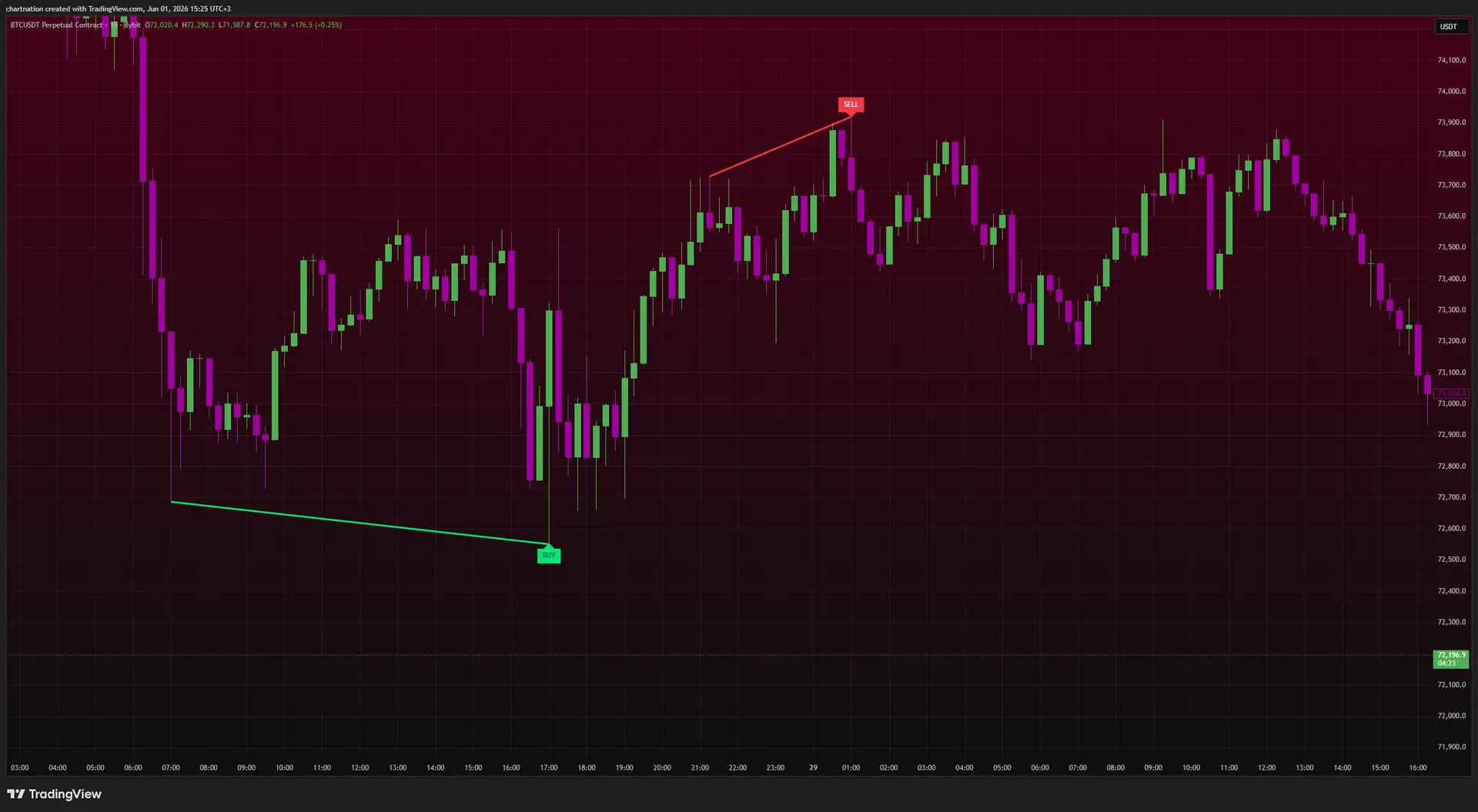
The fix starts with removing human discretion from the pivot selection. This is the core idea behind the Smart Divergence Engine on TradingView. Instead of letting you draw lines on hope, it locks divergence detection to confirmed structural pivots.
What pivot-locking actually does
A pivot high or low isn’t confirmed until price has put in a defined number of bars on either side of it. That means the swing is structurally real — not a candle that’s still forming, not a wiggle you wished into a top. The Smart Divergence Engine only compares confirmed pivots. No repainting your bias onto the chart. No connecting random points.
The practical impact: the signal count drops dramatically, and the signals that survive are anchored to real swing structure. You stop seeing 40 phantom divergences a day and start seeing the handful that actually matter on BTC, XAU, ES, and NQ.
The Shark Fin exhaustion filter
Pivot-locking fixes the “which points” problem. The Shark Fin exhaustion filter fixes the “is this actually done” problem. This is the piece almost no retail divergence setup has.
Shark Fin looks for the signature of a parabolic, climactic push — the kind of overextended thrust that precedes a sharp reversal rather than a slow grind. When divergence lines up with a Shark Fin exhaustion read, you’re no longer just betting that momentum is fading. You’re getting confirmation that the move has gone vertical and is running out of fuel. That’s the difference between catching the top of a blow-off and getting steamrolled by a healthy trend.
Adaptive volatility bands
The Smart Divergence Engine also wraps signals in adaptive volatility bands. Why does this matter? A 1% wiggle on a quiet ES session is meaningful. A 1% wiggle on a high-volatility BTC day is nothing. Static thresholds treat both the same and generate garbage in volatile conditions. Adaptive bands scale to current volatility, so the engine demands a bigger displacement to flag a signal when the market is wild — and stays sensitive when it’s calm.
What This Looks Like in Practice
Say NQ rips into a new high during the cash open. Standard retail divergence: you see RSI lower, you short, you pray.
With the Smart Divergence Engine, the sequence is different:
- Pivot confirmation — the engine waits for the swing high to actually confirm before flagging anything. No premature short into strength.
- Divergence on locked pivots — it compares the confirmed high against the prior confirmed high. If RSI is genuinely lower on structurally valid pivots, you get a flag.
- Shark Fin check — if the push into that high was a parabolic exhaustion thrust, the filter confirms it. Now you have momentum weakness plus exhaustion.
- Volatility context — the adaptive bands confirm the move is overextended relative to current conditions, not just noise.
That’s a stacked, rules-based signal instead of a line you drew because you wanted to be short. It won’t be right every time — nothing is — but it filters out the low-quality setups that blow up retail accounts.
Stack It With Confluence
Divergence is strongest when it’s not standing alone. The traders who use the Smart Divergence Engine well combine it with the rest of the suite:
- An exhaustion divergence on BTC right into a Point of Control or High Volume Node from Volume Matrix Pro is a far better setup than divergence in dead space.
- Layer in an institutional order flow zone from Flow Dynamics Pro with a high confluence score (0–100), and you’ve got momentum, structure, and positioning all pointing the same way.
- Add Smart Moving Average Dynamics (SMAD) to confirm the trend is actually rolling over, not just pausing.
That’s the whole point: stop trading single signals on hope. Trade confluence on structure.
The Bottom Line
RSI divergence doesn’t fail because the concept is wrong. It fails because retail runs it with subjective pivots, no structure, and no exhaustion filter — guaranteeing they front-run strong trends and get stopped out. Pivot-locking removes the discretion. The Shark Fin filter confirms exhaustion. Adaptive volatility bands keep you out of the noise. Together they turn divergence from a guess into a signal you can actually build rules around.
Want to see pivot-locked divergence on your own charts? The Smart Divergence Engine is included in the Pro and Ultimate tiers on TradingView. Start your 7-day free trial at chartnation.net and run it on BTC, XAU, ES, and NQ before you commit a dollar.
Trading involves significant risk of loss. ChartNation indicators are tools for analysis only and do not constitute financial advice. Past performance shown is not indicative of future results.